
Traducción del original en inglés realizada por MST Engineering. Ver original
Bourns SRP1038A-R36M vs MAZO LPCA-1040-R36-M
Verdict: Close. Check your peak current and temperature first.
The MAZO part has the same inductance, the same DCR and the same pad span. It saturates earlier, its temperature limit is 25 °C lower and it has no AEC-Q200 statement.
| Bourns SRP1038A-R36M | MAZO LPCA-1040-R36-M | Result | |
|---|---|---|---|
| Inductance | 0.36 µH ±20 % @ 100 kHz, 1 V | 0.36 µH ±20 % @ 1 MHz, 1 V | Same value; test frequency differs |
| DCR typ / max | 1.05 / 1.2 mΩ | 1.05 / 1.2 mΩ | Same |
| Heating current | 31 A (40 °C rise) | 30 A typ (≈40 °C rise) | 1 A lower |
| Saturation current | 60 A (20 % L drop) | 50 A typ (≈30 % L drop) | Lower; about 40 A at a 20 % drop on the MAZO curve |
| Body | 11.0±0.5 × 10.0±0.3 × 3.8±0.2 mm | 11.5 max × 10.0±0.3 × 3.8±0.2 mm (4.0 max) | Same envelope |
| Land pattern | 2 pads 4.1 × 3.5 mm, gap 5.4, span 13.6 | 2 pads 4.1 × 4.1 mm, gap 5.4, span 13.6 | Same span and gap; MAZO pad 0.6 mm longer |
| Operating range (incl. self-heating) | −55 to +150 °C | −55 to +125 °C | 25 °C lower |
| AEC-Q200 | Compliant | Not stated | Missing |
MAZO LPCA-1040-R36-M
$0.53 /pc from 5 pcs
- 5–49 pcs: $0.53
- 50–149 pcs: $0.39
- 150–499 pcs: $0.324
- 500–2,999 pcs: $0.226
Same 0.36 µH, DCR and pad span. Keep peak current below about 40 A and the part at or below 125 °C.
MAZO VCMA-1040-R36-M-1A (AEC-Q200)
$0.52 /pc from 5 pcs
- 5–49 pcs: $0.52
- 50–149 pcs: $0.37
- 150–499 pcs: $0.302
For automotive designs: same body, AEC-Q200, Idc 32 A typ / 30 A max, Isat 54 A typ / 50 A max (≈30 % drop), −55 to +125 °C.
Power inductor selection guide · All MAZO power inductors
Not an equivalent or drop-in part. Verify efficiency, temperature rise and ripple in your circuit before you change the BOM. Freight, duties and tax are confirmed separately; transit time comes on top of dispatch preparation.
Valores principales de la hoja de datos (hoja de datos Bourns SRP1038A Series)
| Parámetro | SRP1038A-R36M | Condición / nota |
|---|---|---|
| Inductancia | 0.36 µH ±20 % | @ 100 kHz / 1 V |
| Q (mín.) | 15 | @ 100 kHz / 1 V |
| SRF | 105 MHz típica | |
| DCR | 1.05 mΩ típica, 1.2 mΩ máx. | |
| Irms | 31 A | Aumento de temperatura de 40 °C a la Irms nominal |
| Isat | 60 A | La inductancia cae un 20 % a Isat |
| Temperatura de funcionamiento | –55 °C a +150 °C | Incluye el aumento de temperatura |
| Temperatura de almacenamiento | –55 °C a +150 °C | |
| Dimensiones | 11.0 ±0.5 × 10.0 ±0.3 mm, altura 3.8 ±0.2 mm | |
| Núcleo / acabado de terminales | Núcleo de polvo carbonílico; terminales de Sn | |
| Homologación | Conforme con AEC-Q200; conforme con RoHS, sin halógenos | |
| MSL | 1 | |
| Embalaje | 500 pcs por carrete de 13 pulgadas |
Candidatos de referencia cruzada en la tienda MST (por verificar, no equivalentes)
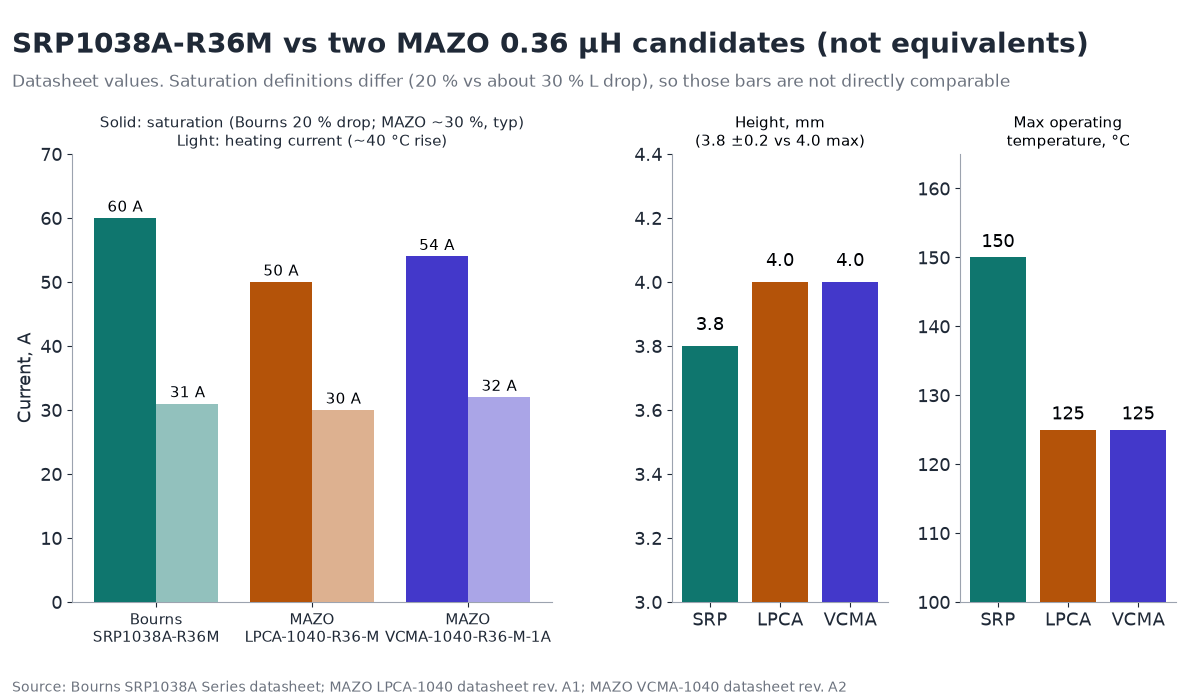
| Parámetro | Bourns SRP1038A-R36M | MAZO LPCA-1040-R36-M | MAZO VCMA-1040-R36-M-1A |
|---|---|---|---|
| Inductancia | 0.36 µH ±20 % @ 100 kHz, 1 V | 0.36 µH ±20 % @ 1 MHz, 1.0 V | 0.36 µH ±20 % @ 1 MHz, 1.0 V |
| DCR típica / máx. | 1.05 / 1.2 mΩ | 1.05 / 1.2 mΩ | 0.95 / 1.2 mΩ |
| Corriente de saturación | 60 A (caída del 20 %) | 50 A típica (caída de aproximadamente el 30 %) | 54 A típica, 50 A en la columna de máximo (caída de aproximadamente el 30 %) |
| Corriente de calentamiento | 31 A (aumento de 40 °C) | 30 A típica (aumento de aproximadamente 40 °C) | 32 A típica, 30 A en la columna de máximo (aumento de aproximadamente 40 °C) |
| Tamaño | 11.0 × 10.0 × 3.8 mm | 11.5 × 10.3 × 4.0 mm máx. | 11.5 × 10.3 × 4.0 mm máx. |
| Temperatura de funcionamiento | –55 a +150 °C | –55 a +125 °C | –55 a +125 °C |
| AEC-Q200 | Sí | No se indica | Sí |
- No son equivalentes según las hojas de datos. Las corrientes de saturación utilizan distintas definiciones (caída del 20 % frente a aproximadamente el 30 %), por lo que 60 A frente a 50/54 A no pueden compararse directamente. La inductancia se ensaya a distintas frecuencias.
- Las piezas de MAZO son más grandes y más altas (4.0 mm máx. frente a 3.8 ±0.2 mm), y su temperatura máxima de funcionamiento es inferior (125 °C frente a 150 °C). Compruebe el espacio libre en altura, el patrón de pads y el margen térmico.
- Los máximos de DCR coinciden (1.2 mΩ), y las corrientes de calentamiento están en el mismo rango para un aumento similar de 40 °C.