
Short answer: An OEM number such as AMAT 0200-10073 identifies a part, not a material grade. Public reseller listings put quartz, sapphire, ceramic, AlN and even graphite items under the same 0200- prefix, so the prefix alone doesn't tell you the material. The material is defined on the OEM drawing. When a supplier offers "high-purity quartz", ask for the grade and the datasheet revision. Heraeus HSQ® 300 and 330 differ only in Na, K and Cu in the current sheet. Synthetic grades trade OH content and high-temperature limits against purity. Different makers' tables use different units and column orders.
What the part number tells you, and what it doesn't
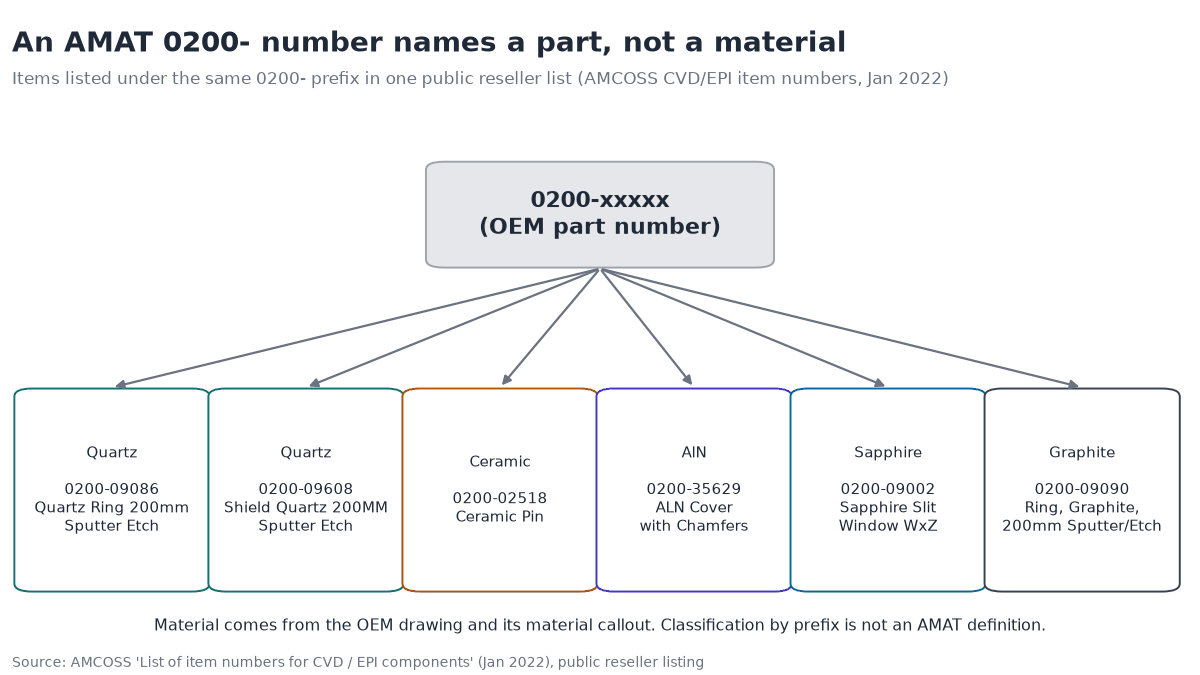
AMAT does not publish a public decoder for its part-number prefixes. What we can see is how public listings use them:
- Asseta lists AMAT 0200-10073 as "INSULATOR,QUARTZ,200MM, SIMPLE CATHODE", with market activity "Requested multiple times · most recently December 2023".
- AMCOSS's public "List of item numbers for CVD / EPI components" (Jan 2022) maps its own item numbers to OEM numbers. Under the 0200- prefix it lists, among others: "Quartz Ring 200mm Sputter Etch" (0200-09086, P5000), "Ring QTZ THK 150mm Sputter Etch" (0200-09087), "Shield Quartz 200MM Sputter Etch" (0200-09608), "Ceramic Pin" (0200-02518, Producer), "ALN Cover with Chamfers" (0200-35629, DxZ), "Sapphire Slit Window WxZ" (0200-09002) and "Ring, Graphite, 200mm Sputter/Etch" (0200-09090).
Two takeaways:
1. 0200- is not "quartz". In this one list it covers quartz, ceramic, AlN, sapphire and graphite parts. Classify by the description and the drawing, not the prefix. Evidence level: observed in public reseller listings, not an AMAT definition.
2. Descriptions can contradict themselves. The same AMCOSS list shows 0200-09005 as "Window Sapphire" with "(Quartz)" printed under the number. Some entries carry a "~" before the OEM number (e.g. "~0200-02518" for "Ceramic Pin w/o tip"), and the list doesn't explain it. Resolve both kinds of ambiguity with the drawing or a photo of the old part before quoting.
Interchangeability between an OEM 0200- part and any non-OEM ("compatible") quartz part is not established by any of these listings.
Material grades: two makers' tables, side by side
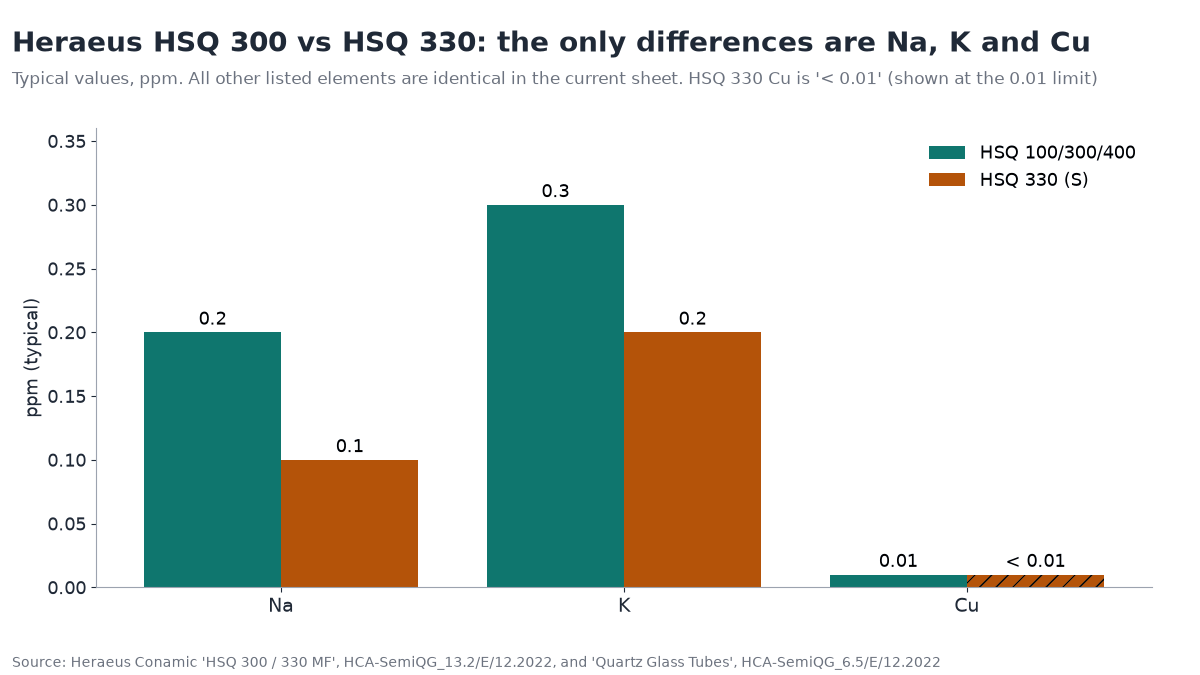
Heraeus (Conamic) – current sheets. "Quartz Glass Tubes" (HCA-SemiQG_6.5/E/12.2022) and "HSQ® 300 / 330 MF" (HCA-SemiQG_13.2/E/12.2022). Both say data is correct as of June 2022. Typical values, ppm:
| Grade | Type | Li | Na | K | Ca | Fe | Cu | Ti | Zr | Al | OH |
|---|---|---|---|---|---|---|---|---|---|---|---|
| HSQ® 100/300/400 | electrically fused | 0.5 | 0.2 | 0.3 | 0.5 | 0.1 | 0.01 | 1.1 | 1.0 | 15 | < 30* |
| HSQ® 330 (S) | electrically fused | 0.5 | 0.1 | 0.2 | 0.5 | 0.1 | < 0.01 | 1.1 | 1.0 | 15 | < 30* |
| HSQ® 700 | electrically fused | < 0.01 | < 0.02 | 0.1 | 0.4 | 0.1 | < 0.01 | 1.1 | 1.0 | 15 | < 30* |
| HSQ® 900 | synthetic | < 0.002 | < 0.01 | < 0.01 | < 0.02 | < 0.03 | < 0.001 | < 0.03 | < 0.04 | < 0.04 | 0.2 |
| HSQ®-T | synthetic | < 0.01 | < 0.01 | < 0.01 | < 0.02 | < 0.01 | < 0.01 | < 0.01 | < 0.01 | < 0.01 | 150–200 |
*"OH content can be reduced by additional annealing." (Mg, Cr, Ni, Mn columns omitted here for width. See the source.)
Momentive Technologies – "Quartz Tubes" (2-page PDF, © 2025). "Typical Momentive quartz grade impurity levels (PPMW)":
| Grade | Positioning (Momentive) | Al | Ca | Cu | Fe | Li | K | Na | Ti | Zr |
|---|---|---|---|---|---|---|---|---|---|---|
| 214 | High purity, natural sand | 15 | 0.5 | < 0.04 | 0.2 | 0.5 | 0.4 | 0.8 | 1.0 | 0.9 |
| 224 | Low alkali | 8 | 0.6 | < 0.003 | 0.2 | 0.2 | 0.1 | 0.1 | 1.4 | 0.6 |
| 244 | Low aluminium / low alkali | 8 | 0.6 | < 0.003 | 0.2 | 0.2 | 0.1 | 0.1 | 1.4 | 0.6 |
| 021 | Ultra-high purity, synthetic sand | 0.02 | < 0.05 | < 0.03 | 0.08 | < 0.05 | < 0.05 | < 0.05 | < 0.02 | < 0.05 |
Pitfalls when comparing these tables
- Column order differs. Heraeus starts with Li, Na, K. Momentive starts with Al, Ca, Cu. Copy-paste comparisons often shift a column. Re-key by element name.
- Units and basis differ. Momentive says PPMW. An older Heraeus sheet for CFQ 099 / HSQ 100 / 300 / 700 (copy hosted by a German distributor) labels its table "ppm by weight oxide" and gives different HSQ 300 numbers (e.g. Li 0.6, Na 0.3, K 0.4) from the current sheet (Li 0.5, Na 0.2, K 0.3). Quote the document code and date, not just the grade.
- Momentive's table has no OH column; Heraeus's does. For high-temperature parts OH matters (see below), so ask for it explicitly.
- Two Momentive rows are identical. 224 and 244 have the same impurity numbers in this table, while the positioning text says 244 is the "low Al + low alkali" grade. Ask Momentive or the fabricator which spec actually separates them before using this table to choose between them.
- All values are "typical". Momentive's sheet says customers "must evaluate" its products and "make their own determination as to fitness of use", and points to Certificates of Analysis. Heraeus labels its tables "Typical Values". For a chamber part, the CoA plus the OEM drawing's material callout is what counts.
Electrically fused vs synthetic: the thermal trade-off
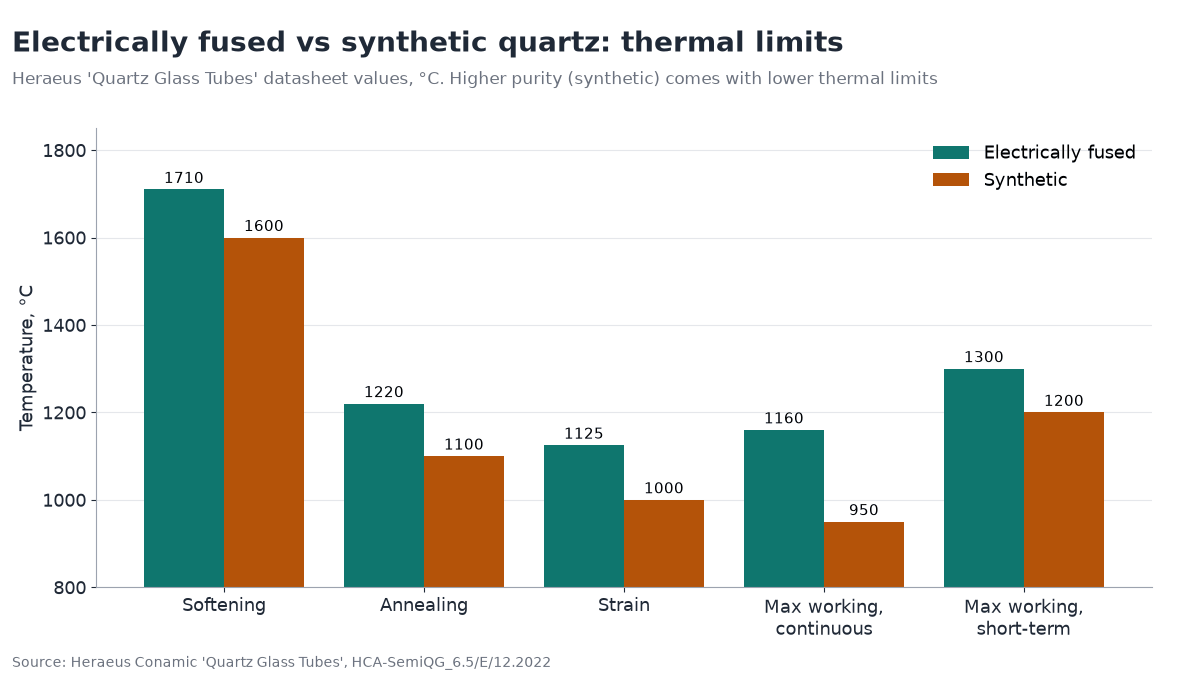
From the Heraeus tubes sheet:
| Property | Electrically fused | Synthetic |
|---|---|---|
| Softening temperature | 1710 °C | 1600 °C |
| Annealing temperature | 1220 °C | 1100 °C |
| Strain temperature | 1125 °C | 1000 °C |
| Max working temperature, continuous | 1160 °C | 950 °C |
| Max working temperature, short-term | 1300 °C | 1200 °C |
Higher purity (synthetic) doesn't automatically mean "better" for a hot part. On this sheet the synthetic family has lower thermal limits, and HSQ-T carries 150–200 ppm OH against < 30 ppm for the electrically fused grades. Heraeus describes HSQ® 300/330 MF's low OH content as making it "suitable for high-temperature applications". For a plasma-etch ring the drivers are different (purity, dimensional tolerance, surface finish). Write down which drivers apply before accepting a substitute grade.
Momentive's 214 sits in a similar Al range (15 ppm) to Heraeus HSQ 300 (15 ppm). That is a similarity in one column, not an equivalence. Interchangeability not established.
How to verify fit before ordering
1. Get the OEM drawing number and revision (or a dimensioned photo of the old part plus the chamber/kit context).
2. Confirm the material callout: quartz type/grade, or "clear fused quartz" with a purity spec.
3. Ask the fabricator which raw-material grade and datasheet revision they will use, and for a CoA per lot.
4. Check critical dimensions and surface finish (fire-polished, mechanically polished, bead-blasted). These come from the drawing, not the material sheet.
5. For "compatible" parts, agree a first-article inspection before series supply.
What to send in an RFQ for a 0200- (or any OEM) quartz part
- OEM part number + description exactly as on the label/BOM (e.g. "0200-10073 INSULATOR, QUARTZ, 200MM").
- Tool platform, chamber, wafer size.
- Drawing and revision if you have it. Otherwise photos with a ruler, plus key dimensions.
- Required material grade or purity spec, and whether OH content is controlled.
- New OEM, new non-OEM (to drawing), or refurbished/cleaned.
- Quantity, CoA / CoC requirements, cleanroom packaging.
FAQ
Does "0200-" mean the part is quartz? No. Public listings show quartz, sapphire, ceramic, AlN and graphite parts under 0200-. Use the description and drawing.
Is HSQ 330 better than HSQ 300? In Heraeus's current table it has lower Na (0.1 vs 0.2), K (0.2 vs 0.3) and Cu (< 0.01 vs 0.01) ppm. The other listed elements are the same. Whether that matters depends on your contamination spec.
Is synthetic fused silica always the right upgrade? Not for high-temperature parts. In Heraeus's data its continuous working limit is 950 °C vs 1160 °C for electrically fused, and HSQ-T's OH is 150–200 ppm.
Applied Materials/AMAT, Heraeus, HSQ, Momentive and 214 are trademarks of their respective owners. OEM names and part numbers are used for identification only. MST is not affiliated with or endorsed by these companies.
Original OEM documents (links only)
1. Heraeus Conamic, "Quartz Glass Tubes" datasheet, HCA-SemiQG_6.5/E/12.2022 (data correct as of June 2022). https://www.heraeus-covantics.com/media/Media/Documents/Products_and_Solutions/SEMI/EN/Quartz_Tubes_EN.pdf
2. Heraeus Conamic, "HSQ® 300 / 330 MF" datasheet, HCA-SemiQG_13.2/E/12.2022. https://www.heraeus-covantics.com/media/Media/Documents/Products_and_Solutions/SEMI/EN/Solids_HSQ300_330MF_EN.pdf
3. Momentive Technologies, "Quartz Tubes" product sheet (© 2025). https://www.momentivetech.com/wp-content/uploads/2026/04/momentive-technologies-quartz-tubes.pdf
Other public references used (reseller/distributor listings, not OEM definitions):
- Heraeus Quarzglas, "CFQ 099 / HSQ 100 / HSQ 300 / HSQ 700 Electrically Fused Quartz Glass" (older sheet, distributor-hosted copy). https://www.quarzglas-heinrich.de/wp-content/uploads/HSQ300.pdf
- Asseta, "AMAT 0200-10073" listing (accessed 2026-10-19). https://www.asseta.com/parts/amat-0200-10073
- AMCOSS, "List of item numbers for CVD / EPI components" (PDF, Jan 2022). https://amcoss.com/wp-content/uploads/2022/01/CVD-EPI-Item-Numbers-01_22.pdf
Request a quote
Need a quartz, ceramic or sapphire chamber part identified or quoted? Include the drawing and revision, or photos with a ruler. Post a find-part request with the details above, or send a sourcing RFQ. MST replies in the thread or by email. MST does not claim stock of any item mentioned here; sourcing is done on request.